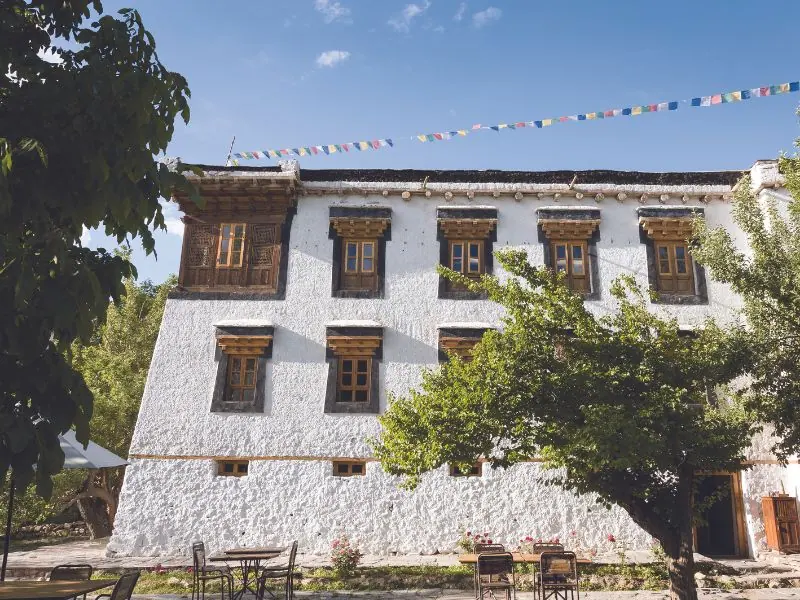

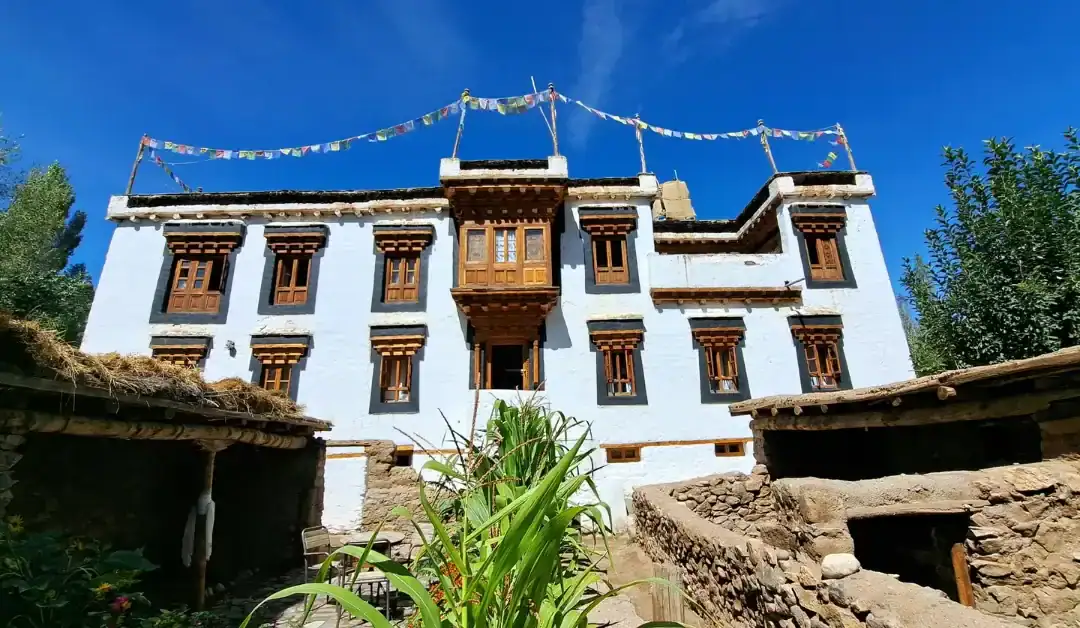
There is a specific moment at Nimmu House that our guests tell us stays with them long after they’ve returned to the hum of London, Mumbai, or New York. It isn’t the moment they see the majestic peaks of the Zanskar range though that is undeniably grand. It is the moment they sit on a hand-carved wooden Rabsal balcony, holding a warm cup of sea buckthorn tea, and realize the only sound they hear is the wind moving through the apricot orchard.
In the world of high-end travel, the term “luxury” has been diluted by an obsession with marble lobbies and automated curtains. But for the discerning traveller, the top hotels of India are no longer defined by how much gold is on the taps, but by the “quiet luxury” of authenticity, heritage, and a deep, rhythmic connection to the land.
In this guide, we explore the shifting landscape of Indian hospitality and why the search for the top hotels in Leh leads many to a 100 + year-old noble house in the village of Nimmu.
Key Takeaways: The New Standard of Indian Luxury
- Heritage over New-Build: Travelers are prioritizing restored historical dwellings that offer a sense of “place.”
- Sustainability as Standard: True luxury now includes farm-to-table dining and a minimal plastic footprint.
- Experiential Leh: The best stays in Ladakh focus on acclimatization, cultural immersion, and architectural preservation.
- The Nimmu Difference: A rare combination of a royal heritage house and high-end glamping in a private orchard.
Redefining the “Top Hotels of India”
India has always been a land of palaces, but the modern “High-Net-Worth” traveller is moving away from the “hotel-as-a-fortress” model. They seek properties that function as gateways to the local culture rather than barriers against it.
When we look at the top hotels of India, we see a common thread: Immersive Heritage. To understand where Nimmu House sits in this ecosystem, one must look at our peers—properties that prioritize soul over spectacle:
- Ahilya Fort, Maheshwar: Where the luxury lies in the slow pace of the Narmada River and the preservation of handloom weaving.
- The Ramathra Fort, Rajasthan: A rugged, authentic escape that offers a window into rural Rajput life far from the tourist crowds of Jaipur.
- Mary Budden Estate, Binsar: A private forest retreat that defines Himalayan “quiet luxury” through its intimacy and ecological sensitivity.
These properties, like Nimmu House, belong to an exclusive “club” of authentic stays. They are for the traveller who values the patina on an ancient wooden beam or the specific flavour of a family recipe passed down through generations. The shift is clear: luxury is no longer about what you can buy; it’s about what you can feel.
The Search for the “Top Hotels in Leh”
Planning a trip to Ladakh is unlike any other journey in India. The altitude (3,500 meters and above) demands respect, and the harsh climate dictates a different kind of hospitality. When searching for the top hotels in Leh, the criteria must change. It is not enough to have a soft bed; a hotel in this region must be a sanctuary for the body and mind.
What Makes a Hotel “Top Tier” in the Himalayas?
- Acclimatization Support: The first 48 hours in Ladakh are critical. A top-tier hotel provides more than just oxygen cylinders; they provide a slow-paced environment and expert guidance on how to hydrate and rest.
- Thermal Comfort: In a land where temperatures can swing 20 degrees in an hour, the use of traditional Ladakhi architectural wisdom—thick mud walls and solar gain—is more luxurious than any central heating system.
- Cultural Stewardship: The best hotels are those that help preserve the fragile Ladakhi culture rather than commodifying it.
- Location: While staying in Leh’s main market offers convenience, the true “top” experience is often found 45 minutes away in the serene village of Nimmu, where the air is clearer and the stars are brighter.

The Nimmu House Experience
Nimmu House was never meant to be a hotel. Built in the early 20th century for the cousin of the King of Ladakh, it was a noble residence a place of power, prayer, and family. When we began the restoration process, we didn’t want to “modernize” it; we wanted to wake it up.
Architecture: A Masterclass in Ladakhi Heritage
The Ladakhi architecture of Nimmu House is a dialogue between earth, wood, and stone. Our guests often marvel at the Rabsal—the iconic protruding wooden balconies. Each one was restored using local poplar and willow, maintaining the intricate carvings that signify its royal past. Walking through the two private temples and the 5 heritage rooms of the house, you aren’t just a guest; you are a temporary custodian of Himalayan history.
Glamping in India: The Orchard Tents
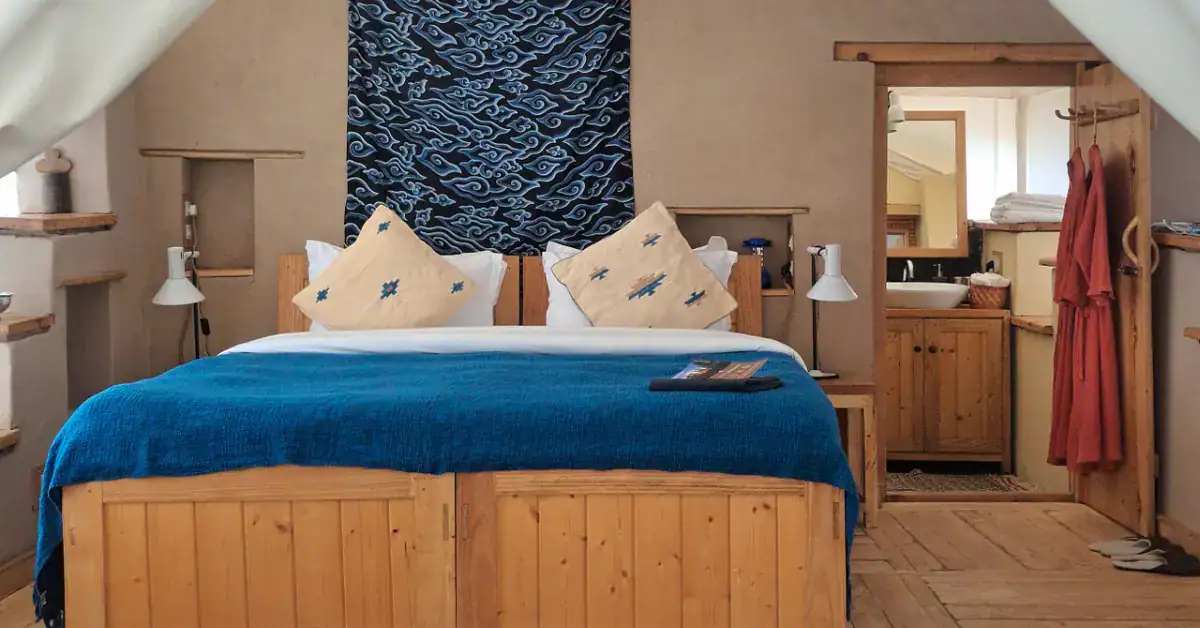
For those who want to be even closer to the elements, we introduced glamping in India with a high-altitude twist. Scattered among our 5,000-square-meter orchard are luxury tents that redefine the camping experience.
- The Setting: Wake up to the scent of apricot blossoms.
- The Comfort: Hand-crafted furniture, plush bedding, and en-suite bathrooms that bring the comforts of a boutique hotel to the middle of an ancient grove.
- The Experience: There is a specific silence at sunrise in the orchard—broken only by the distant chanting from a nearby monastery—that no four-walled room can replicate.
Farm-to-Table: The Ladakhi Palate
Sustainable luxury is best tasted. Our kitchen doesn’t rely on long-haul supply chains. Instead, we look to our own backyard.
- The Orchard: Apricots, apples, and walnuts are harvested meters from your table.
- The Village: We source fresh dairy and grains from Nimmu village, supporting the local economy while ensuring our guests eat the most nutrient-dense food possible essential for altitude health.
- The Signature Dish: Guests often ask for our Skyu (a traditional thumb-pressed pasta stew). It is hearty, warming, and tastes of the mountains.
Through Our Guest’s Eyes
We believe that the true measure of a “top hotel” is the feeling our guests takes home. We often hear that Nimmu House feels less like a commercial hotel and more like returning to a home they never knew they had.
“I came for the mountains, but I stayed for the light in the dining hall at dusk. There is a sense of belonging here. You aren’t just staying in a room; you are part of a village’s heartbeat.” — Recent Guest, Autumn 2025
Our guests appreciate the transparency of our location. We are 45 minutes from Leh—a distance that acts as a filter. It keeps the noise of the city at bay and ensures that those who find us are those who truly value serenity. It is this distance that allows for the deep “quiet luxury” our visitors crave.
A Note on High-Altitude Wellness
- The 48-Hour Rule: Spend your first two days at Nimmu House doing absolutely nothing. Let your body adjust.
- Hydration: Drink more water than you think you need. Our staff will constantly replenish your flask with filtered mountain water.
- Mindfulness: Join our morning yoga sessions in the orchard. The thin air makes you more conscious of every breath—a natural form of meditation.
The Lasting Memory
In the end, the top hotels of India are those that change you. They are the places where you learn something new about the world, and perhaps something new about yourself. Nimmu House offers more than a bed; it offers a vantage point to view a disappearing way of life, wrapped in the comfort of modern, sustainable hospitality.
Whether you are seeking the historical depth of heritage hotels in Ladakh or the adventurous spirit of glamping in India, your sanctuary is waiting in the orchard.
Would you like us to help you plan your acclimatization itinerary or reserve one of our heritage suites for the upcoming harvest season?